October 23rd 2026 in News
Beth Lew-Williams wins 2026 Cundill History Prize for 'John Doe Chinaman'
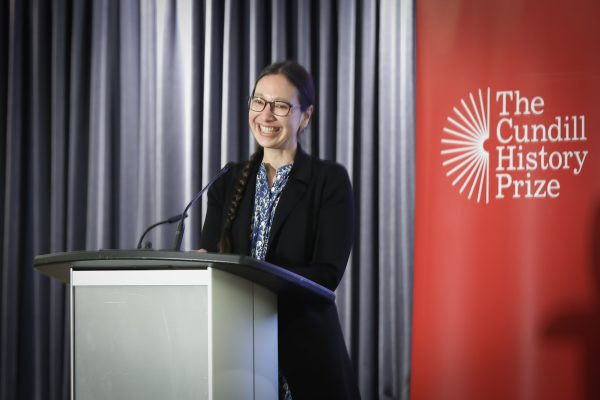
Beth Lew-Williams has won the 2026 US$75,000 Cundill History Prize for John Doe Chinaman: A Forgotten History of Chinese Life under American Racial Law. The announcement was made at the Cundill History Prize Festival in Montreal, where the prize is administered by McGill University.
The 2026 Cundill jurors awarded the prize to Beth Lew-Williams, Professor of History and Director of the Program in Asian American Studies at Princeton University, for her “dazzlingly innovative and hard-hitting” history of the laws that constrained the lives of Chinese immigrants in the 19th century American West. John Doe Chinaman also recovers the stories of the Chinese Americans who negotiated, circumvented, and resisted discrimination, refusing to accept a conditional place in American life.
The announcement was made this evening, 23 October, at an awards ceremony in Montreal by Chair of the Jury Emily Greenwood, in the company of the 2026 finalists and jury members. Fellow finalists, Jonathan Cheng and Alexander Lee, will each be awarded US$10,000.
In her innovative and consequential book, Lew-Williams used extensive quantitative research and big data methods to uncover decades of history of anti-Chinese legislation in the United States. By examining court records, immigration files and personal accounts, she reveals the extent of anti-Chinese discrimination and restores individuality and humanity to lives once obscured by prejudice. In John Doe Chinaman, Lew-Williams presents a new and unexpected history of American racial law and argues that recovering the history of Chinese exclusion is essential to understanding the history of race, racial reconstruction, and immigration in the United States, and more broadly, the western world.
Emily Greenwood, 2026 Chair of the Jury and James F. Rothenberg Professor of Classics at Harvard University, said: “In John Doe Chinaman, Beth Lew-Williams unravels the paradoxes of anti-Chinese racial laws in the American West from the 1850s to the 1920s, analysing the intentions of these laws, their effects, and how Chinese migrants responded to them. These laws were part of a larger racial regime, one of whose consequences was to contain and suppress the lives of Chinese migrants, reducing them to anonymous stereotypes—the “John Doe Chinaman” of the title. Using a supple combination of data algorithms to process legal and bureaucratic records and trenchant storytelling, Lew-Williams documents the ghosting of these lives in the historical record, retrieving Chinese voices that show us some of what we are missing. This is a dazzlingly innovative and hard-hitting work.”
Ned Blackhawk, Howard R. Lamar Professor of History at Yale University, said: “At a time when debates about citizenship and deportation are roiling the United States, Beth Lew-Williams reaches back into long-standing histories of race and exclusion. Across the American West, Chinese communities became targeted by local communities who used laws and violence to limit immigration. No one has excavated such intertwined histories so forcefully. Meticulous, convincing, and written with a driving confidence, John Doe Chinaman is a remarkable achievement.”
Fergal Keane, award-winning BBC journalist and author, said: “Beth Lew-Williams has produced a landmark work. She weaves together deep and original archival research, brings into the light story that has not been given the wider attention it deserves, and all of this in prose that is vivid and engaging at every turn. Race and the weaponization of the fears around it is a subject that is powerfully resonant today. This is not only a compelling read, but an essential one.”
Barbara Weinstein, Silver Professor of History at New York University and past President of the American Historical Association, said: “With John Doe Chinaman, Beth Lew-Williams has made a stellar contribution to the growing historical literature on immigration and migration to the Americas, and especially on the experience of immigrants who were seen as highly desirable for their labour but undesirable as citizens. It is this seeming paradox of inclusion and exclusion that forms the interpretive scaffolding for this study of the severe challenges that Chinese immigrants faced while living “under American racial law,” and the many courageous and creative responses that this experience called forth. This book is also a marvellous example of the way a gifted historian, by posing new questions and analysing new sources, can illuminate the experiences of people who, at first glance, seem to be nearly invisible in the historical archives.”
Beth LEW-WILLIAMS is Professor of History and Director of the Program in Asian American Studies at Princeton University. She is the author of The Chinese Must Go: Violence, Exclusion, and the Making of the Alien in America.
Beth Lew-Williams joins an exceptional alumni list of world-class historians: Lyndal Roper (2025), Kathleen DuVal (2024), Tania Branigan (2023), Tiya Miles (2022), Marjoleine Kars (2021), Camilla Townsend (2020), Julia Lovell (2019), Maya Jasanoff (2018), Daniel Beer (2017), Thomas W. Laqueur (2016), Susan Pedersen (2015), Gary Bass (2014), Anne Applebaum (2013), Stephen Platt (2012), Sergio Luzzatto (2011), Diarmaid MacCulloch (2010), Lisa Jardine (2009) and Stuart B. Schwartz (2008).
Share this
Archive
2026: July (1) September (2) October (1)2025: February (1) March (1) July (1) September (2) October (1)
2024: February (1) March (1) May (1) August (1) September (2) October (2)
2023: February (1) June (1) September (1) October (1) November (1)
2022: March (1) June (1) September (2) October (1) December (1)
2021: February (1) April (1) September (2) October (1) December (1)
2020: February (1) May (1) September (2) October (1) December (1)
2019: March (1) June (1) September (2) October (1) November (2)
2018: April (1) June (1) September (2) October (1) November (1)
2017: May (1) July (1) September (1) October (2) November (1)
Recent Posts
Beth Lew-Williams wins 2026 Cundill History Prize for 'John Doe Chinaman'
The 2026 Cundill History Prize Finalists
The 2026 Cundill History Prize Shortlist
The 2026 Cundill History Prize Longlist
Lyndal Roper wins 2025 Cundill History Prize for Summer of Fire and Blood
Freedom, Independence and Choice: Finalists for the 2025 Cundill History Prize Announced
The 2025 Cundill History Prize Shortlist
The 2025 Cundill History Prize Longlist